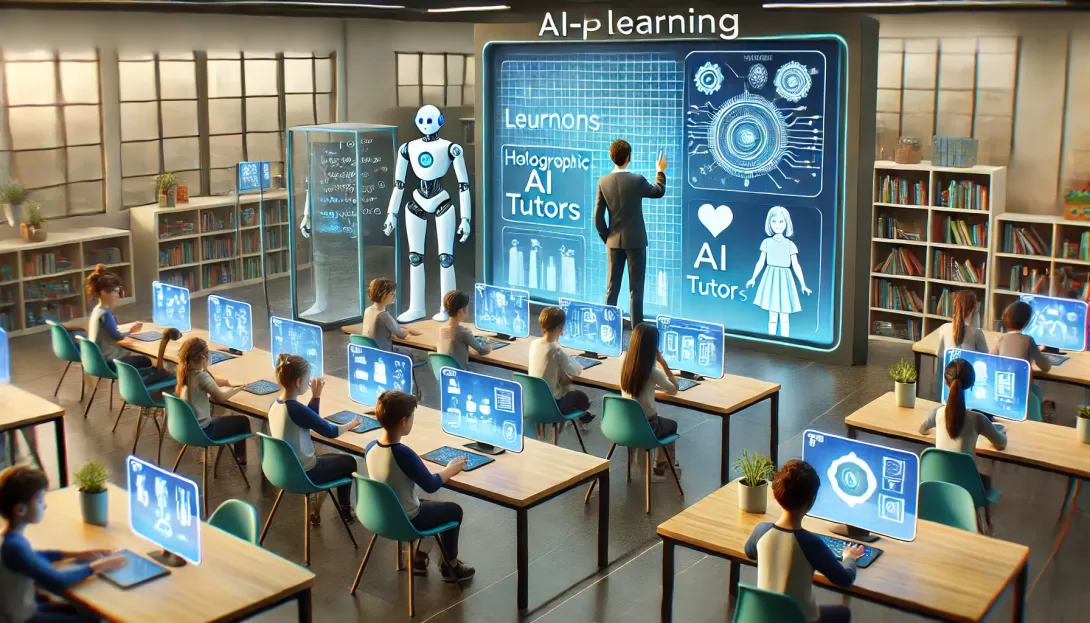
Introduction
Our world is evolving more quickly than ever before due to artificial intelligence (AI). AI is affecting every aspect of daily life, from chatbots that respond to consumer inquiries to self-driving cars. However, are we equipping kids to deal with this new reality?
Standardized testing and memorization were the norm in the time period for which traditional education was created. That is insufficient now. AI is changing industries, occupations, and even education. Schools need to change to stay relevant. Both teachers and students require innovative methods of instruction. We'll look at how education ought to evolve in this blog to get the next generation ready for a world powered by artificial intelligence.
1. Rethinking Our Education: Future-Proof AI Skills
Students used to concentrate on reading, writing, and math. Even though these fundamentals are still crucial, new abilities are needed for the future. Since monotonous tasks are already being automated by AI, students will need to be innovative problem solvers.
The following essential topics must be covered in every curriculum:
- AI Literacy: Students should comprehend how AI functions, as well as its advantages and disadvantages, much like they would while learning how to operate a computer.
- Coding & Data Science: Students who possess even rudimentary programming skills can better comprehend how AI works.
- Critical Thinking & Problem-Solving: Humans must concentrate on using their creativity and problem-solving skills to tackle complicated issues, while AI can perform many mundane activities.
- Ethics & AI Responsibility: As AI advances, worries about justice, bias, and privacy also grow. Students who learn ethics will be better able to employ AI responsibly.
Students will be better prepared for their future occupations if these subjects are taught in schools early on. AI is influencing sectors like healthcare, banking, and even the arts; it's not just for IT professions.
2. Soft Skills Are More Important Than Before
AI excels at data analysis, math crunching, and even report writing. What does AI lack, though? Soft skills and human emotions.
People with excellent leadership, emotional intelligence, and communication skills will still be needed in the jobs of the future. This is the reason:
- Creativity & Innovation: While AI can help with ideas, innovation is primarily driven by humans.
- Emotional Intelligence: While AI can simulate emotions, it is unable to fully comprehend human emotions.
- Collaboration & Teamwork: Even in an AI-driven environment, it will always be beneficial to collaborate successfully with others.
- Adaptability: As AI develops further, the capacity to pick up new abilities fast will become essential.
The goal of education must change from merely imparting knowledge to assisting students in acquiring these vital life skills.
3. AI as a Teaching Assistant in Personalized Learning
Personalization is among AI's greatest benefits. The majority of schools currently employ a "one-size-fits-all" strategy. Students, however, learn differently and at varying rates. AI can assist in customizing lessons for each student.
Consider:
- AI tutors assisting learners who require additional practice.
- Intelligent learning systems making lesson recommendations based on a student's areas of strength and weakness.
- Real-time feedback that enables pupils to get better.
Teachers won't be replaced as a result of this. AI can instead free up teachers to concentrate on what really counts—guiding, motivating, and mentoring students.
4. Lifelong Learning: Learning Continues After Graduation
You attended school, found employment, and worked in the same field until you retired years ago. That isn't the case now. Because AI is transforming sectors so rapidly, workers need to continue learning throughout their lifetimes.
This change necessitates that education become an ongoing endeavor. To enable children to acquire new talents in the future, schools should:
- Teach them how to learn.
- Promote certificates and online education as components of job advancement.
- Assist students in cultivating a growth mentality, which views difficulties as chances rather than barriers.
Regardless of age, the future belongs to those who never stop learning.
5. Digital Responsibilities and Ethics: Educating Students on AI Sensibly
Although AI is strong, it is not flawless. It has the power to propagate false information, strengthen prejudices, and even render unjust judgments. Students need to learn digital responsibility because of this.
What does this signify?
- Recognizing AI Bias: AI is biased, and it will be biased if the data it uses to learn is skewed. Pupils ought to understand this and approach AI-generated content critically.
- Privacy Awareness: A lot of websites and apps gather information. It is essential to teach pupils how to safeguard their data.
- Verifying the Accuracy of AI Outputs: Students need to learn to double-check material before believing it thanks to tools like ChatGPT and deepfake technology.
We equip students to utilize AI responsibly and ethically by teaching them these ideas.
Conclusion
Our world is changing due to AI, and education needs to adapt as well. The following should be the main priorities of schools:
- Teaching coding, AI literacy, and problem-solving techniques.
- Fostering soft skills like collaboration, emotional intelligence, and creativity.
- Making use of AI-driven customized learning resources.
- Promoting adaptation and lifelong learning.
- Teaching pupils about digital responsibility and AI ethics.
Although change won't happen right away, little actions now can have a significant impact later on. We can make sure that the future generation is not only prepared for but also leading an AI-powered world by rethinking education now.
What are your thoughts? How should education change to keep up with artificial intelligence? Leave a comment with your ideas!
Comments